Screen printing: definition, how it works, and when to choose it
Screen printing is a textile printing technique that deposits ink onto a garment through a screen (a stencil stretched with a fine mesh), one color at a time. It's the go-to technique for large runs of designs with bold, clearly defined colors: the ink embeds into the fabric's fibers and holds up very well to washing.
The essentials in 3 points:
- Screen printing prints ink through a screen, one color at a time: each added color has a setup cost.
- It becomes cost-effective from a large enough quantity of identical pieces onward: beyond that, the price per piece drops sharply.
- The ink penetrates the fabric and lasts very well over time, unlike some techniques applied on the surface.
How it works, in plain terms
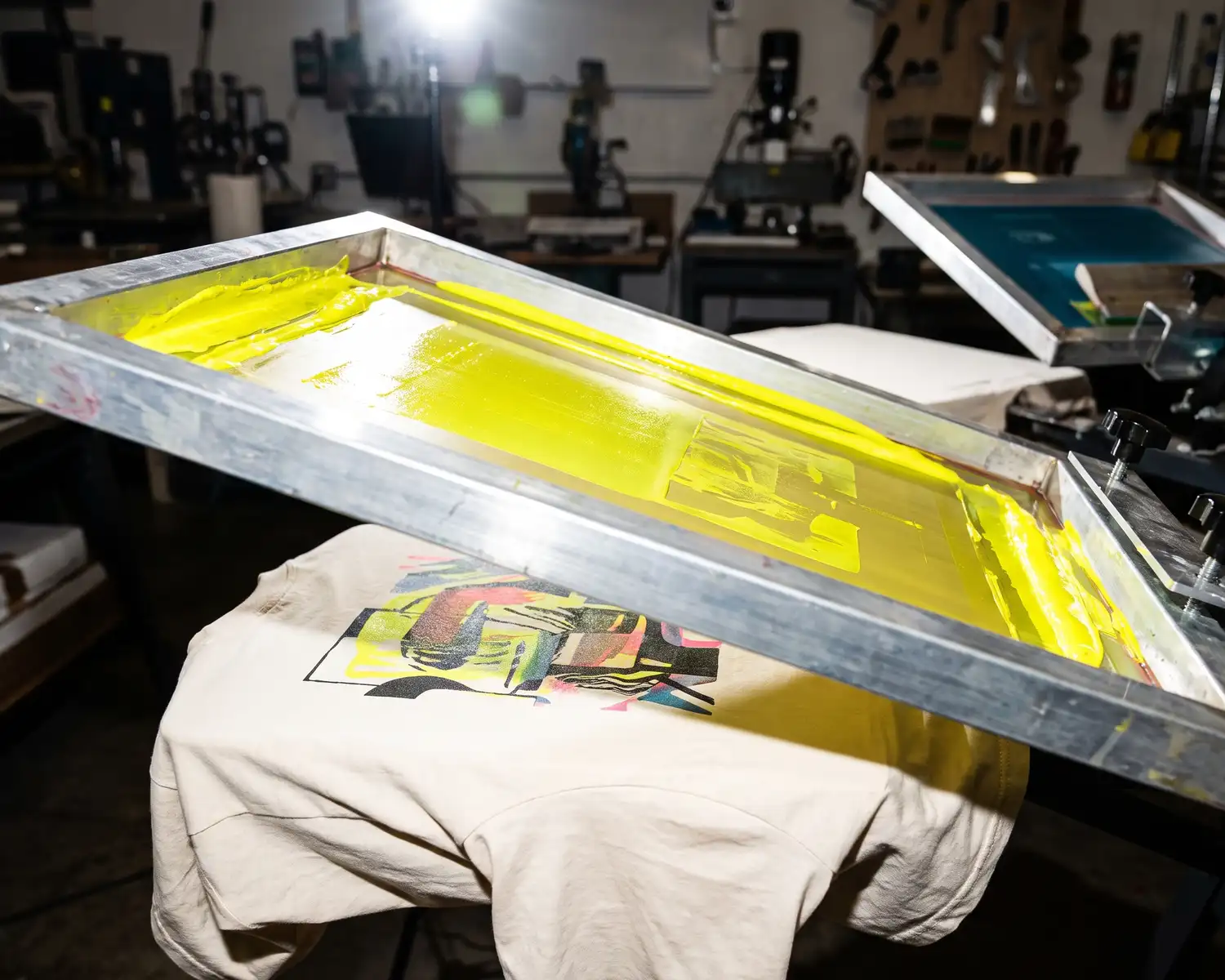
For each color in the design, the workshop prepares a separate screen (a frame stretched with a fine mesh, with part of it blocked to form the design). The ink is dragged through the open areas of the screen, directly onto the fabric. A 3-color design therefore requires 3 screens and 3 passes, one per color.
This preparation (setting up the screens, called "calage" in French) has a fixed cost, whether you're printing 20 or 500 pieces. That explains two things at once: why screen printing is expensive for very small quantities, and why it becomes the cheapest technique per piece once the run is large enough.
When screen printing is the right choice
Three situations where screen printing almost always wins:
- A large quantity of identical pieces. The larger the run, the more the fixed setup cost gets diluted across each piece.
- A design with few, clearly defined colors. Screen printing excels at clean solid areas; a gradient or a complex photo doesn't suit it well.
- A need for long-term durability. Ink embedded in the fiber holds up well to repeated washing.
Conversely, for a small quantity, a very detailed or multicolor design, other techniques (embroidery, DTF, DTG) are often better suited. The full technique comparison details the precise thresholds and special cases.
FAQ
Questions fréquentes
From how many pieces does screen printing become worthwhile?
It depends on the workshop and the number of colors in the design, but the break-even point is most often between 20 and 50 pieces. Below that, the fixed setup cost weighs too heavily on each piece.
Does screen printing work on all textiles?
It works well on most flat textiles (cotton, polyester), but less well on very textured or stretchy surfaces, where the ink can crack over time.
Screen printing or embroidery, what's the difference?
Screen printing deposits ink on the surface of the fabric; embroidery stitches thread directly into the material. The look, durability, and budget differ significantly depending on the technique chosen.
Passer à l'atelier
Vous savez ce qu'il vous faut. Trouvez l'atelier qui le fait.
L'annuaire recense les ateliers ville par ville, avec leurs techniques et leur contact direct. Un devis rapide vous répond sous 24 h.