Choose screen printing for a run of several dozen identical pieces: it is the most economical and most durable option at volume. For a small quantity or a very colorful design, go with DTF. Vinyl transfer (flex) remains useful mainly for names and numbers on jerseys.
The essentials in 4 points:
- Screen printing becomes the cheapest option from a few dozen identical pieces: the ink penetrates the fiber, so the print wears with the fabric instead of peeling.
- DTF prints photos, gradients and complex logos with no extra cost per color, and stays cost-effective from a single piece.
- What most people call "flocking" in France is actually heat transfer vinyl (flex): reliable for names and numbers on jerseys, prone to cracking on large designs.
- Between 20 and 50 pieces, get quotes for both techniques: that is the zone where everything can tip.
You want custom t-shirts or sweatshirts for your team, your association or your event, and one question keeps coming up in your searches: screen printing or vinyl? Here is what no comparison tells you upfront: in everyday speech, "flocage" (the French word for flocking) no longer refers to a precise technique. It has become the generic word for "printing something on a t-shirt". And the result you picture when you say it, that clean, durable print, is most often achieved today through screen printing or DTF, not flocking in the strict sense.
This guide puts all three garment decoration techniques back in their rightful place. Kosmos Network lists hundreds of workshops that practice all of them: we have no machine to pay off, so no reason to steer you anywhere but toward your own interest.
"Flocking": the word everyone says, the technique almost nobody wants
Let's untangle the vocabulary first, because it causes real misunderstandings in workshops.
True flocking consists of fixing fine textile fibers onto glue: a velvety, slightly raised finish, the "peach skin" touch of 1990s football jerseys. Today it is a niche choice, almost a vintage style statement.
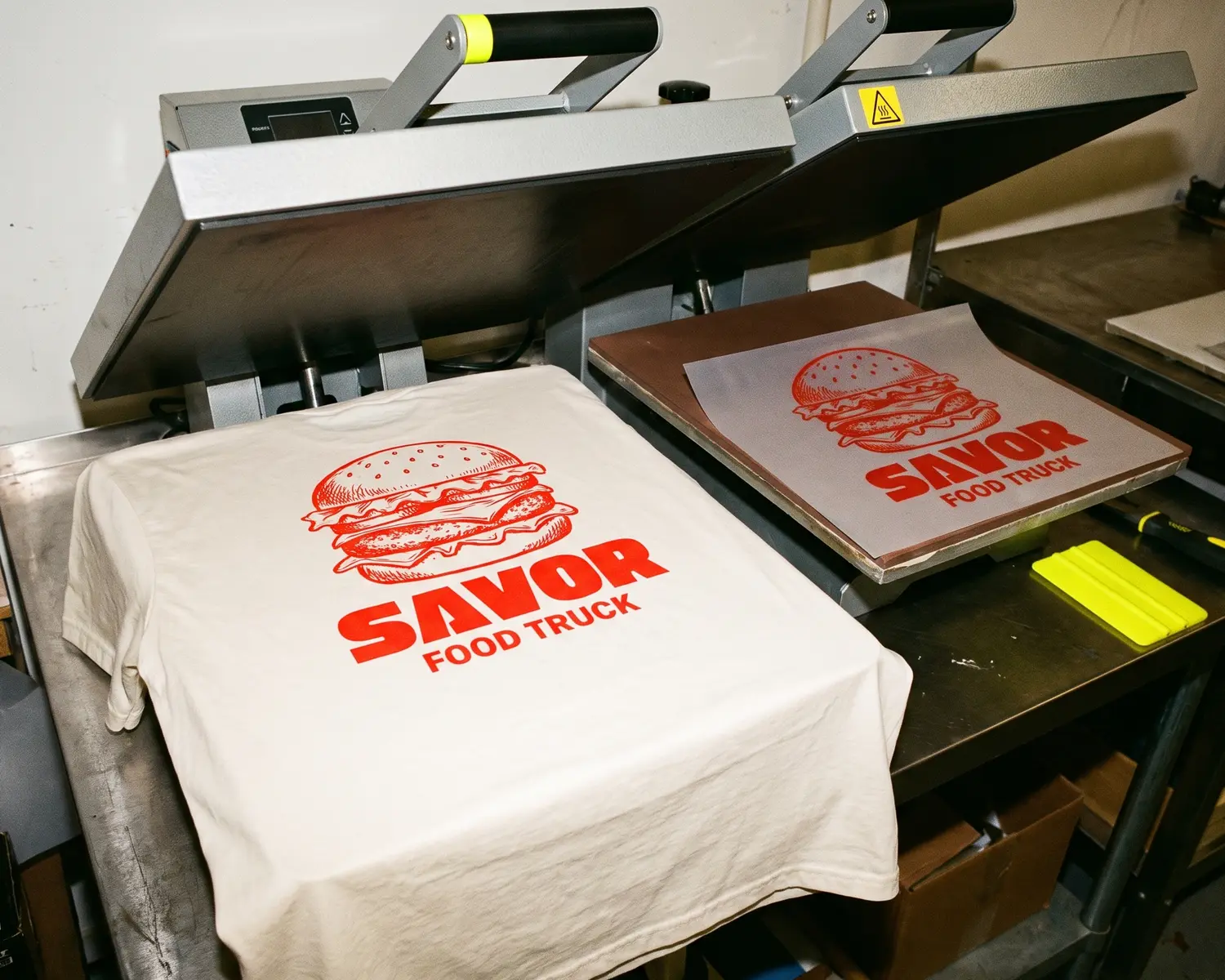
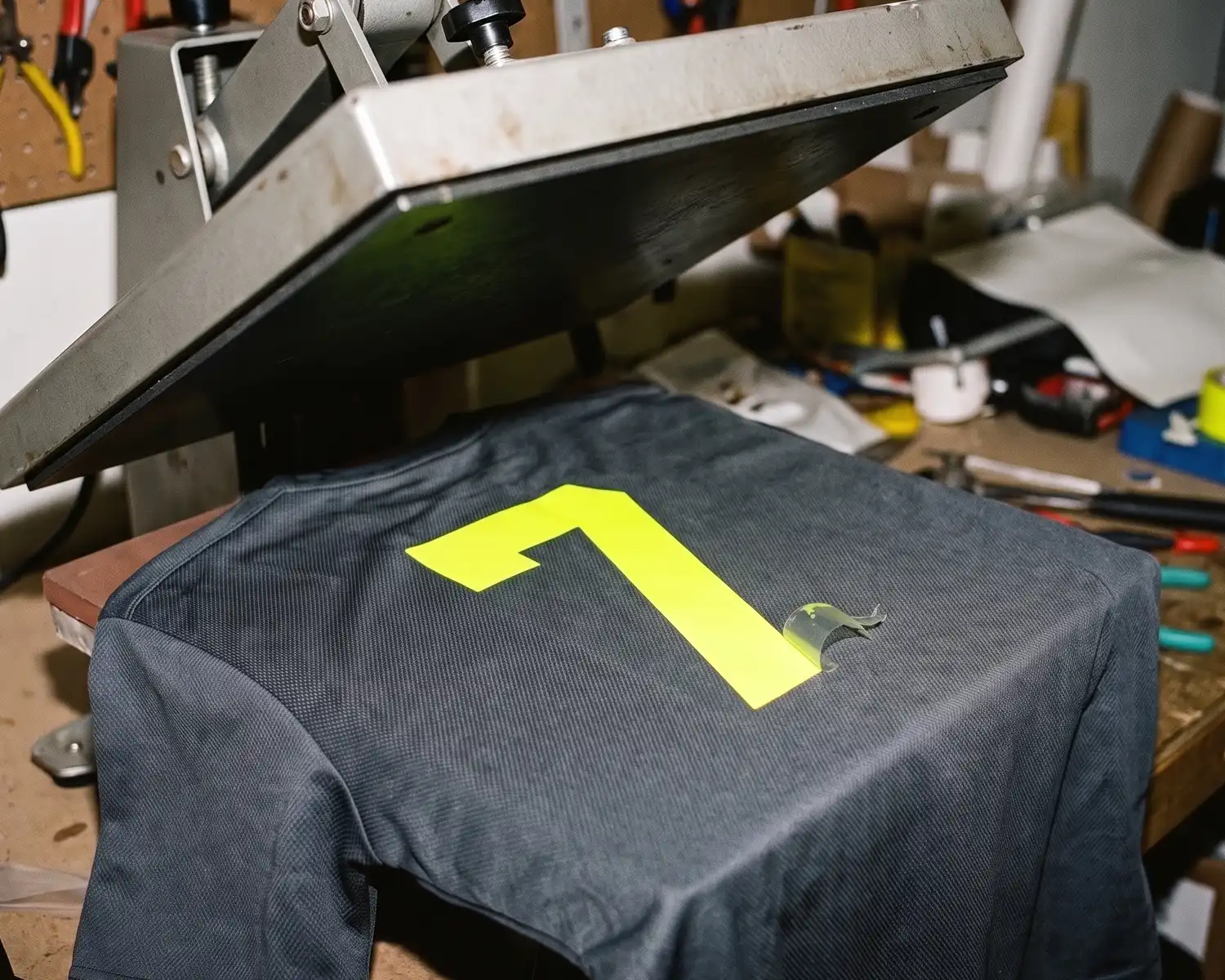
What most people call flocking is actually heat transfer vinyl, or flex: a design cut out of a soft plastic film, then heat-pressed onto the fabric. It is the technique behind names and numbers on jerseys.
And here is the key point: when you say "I want to get t-shirts flocked", you are rarely describing either of these techniques. You are describing a result: a clean design that survives washing and feels good to wear. That result, workshops now achieve mostly through two other processes: screen printing, and DTF.
Why flex is no longer the first choice
Flex has served well, and it keeps legitimate uses we will cover below. But you should know its structural limits, because they explain why workshops themselves reserve it for specific cases.
It is a plastic layer sitting ON the fabric. You can feel it under your fingers, it shines or stiffens depending on the film, and on a large format it turns the back of a t-shirt into a plate that does not breathe. A flex that was badly pressed or washed too hot ends up cracking or peeling at the edges: the event t-shirt whose logo flakes off after one summer.
Each color is a separate film to cut and layer: beyond two colors, application becomes painstaking work billed accordingly. Gradients and photos are out of the question.
Finally, everything is done piece by piece: the cost never goes down with quantity.
Screen printing: the benchmark for runs
Screen printing is direct printing: ink passes through a screen prepared for your design and penetrates the fiber, one color at a time. The print becomes part of the fabric: you can barely feel it, the garment keeps its softness, and it ages gracefully, wearing with the fabric instead of peeling.
Its economics: setup costs (the screens), then a per-piece cost that melts away with volume. Below a few dozen identical pieces, the screens weigh too heavily. Beyond that, it quickly becomes both the cheapest AND the highest-quality option: that double advantage makes it the benchmark for club, class and company orders. And once created, screens can often be reused at the same workshop: an identical reorder costs less than the first run.
Its limits: fine gradients require an experienced workshop, polyester requires specific inks, and it makes no sense for three pieces.
DTF: the modern replacement for flex
DTF (Direct to Film) is a transfer, like flex, but printed: your design is printed in full color onto a film, coated with adhesive, then pressed onto the fabric. The generational difference is clear.
Where flex cuts out solid single-color shapes, DTF prints everything: photos, gradients, complex logos, fine details, with no extra cost per color. The deposited layer is thinner and softer than vinyl, the finish is closer to a print, and a well-pressed DTF holds up very well in the wash. It works on almost any fabric, cotton and polyester alike, and stays cost-effective from the very first piece. More and more DTF transfer workshops offer it, in France and across Europe.
In practice, for a small run with a colorful design, the modern question is no longer "screen printing or vinyl" but "screen printing or DTF". Flex only stays ahead in its historical niches.
Screen printing or vinyl (or DTF): the head-to-head, criterion by criterion
Three decoration techniques, seven criteria. The table first, the details after:
| Criterion | Screen printing | Flex ("flocking") | DTF |
|---|---|---|---|
| Ideal quantity | From a few dozen pieces | Small runs, single pieces | From 1 to a few dozen |
| Colors | All, one screen per color | 1-2 solid colors | All, no extra cost |
| Photos and gradients | Possible at experienced workshops | No | Yes |
| Fabrics | Cotton ideal, polyester with care | Almost all, including jerseys | Almost all |
| Feel | In the fiber, barely noticeable | Noticeable plastic layer | Thin, soft layer |
| Aging | Wears with the fabric, no peeling | Cracking risk | Very good if well pressed |
| Cost vs volume | Drops sharply with quantity | Flat, never degressive | Flat, viable from 1 piece |
Quantity
- 1 to 20-30 pieces: DTF. No setup costs, every piece at the same price.
- Beyond a few dozen identical pieces: screen printing takes the economic lead, and the lead grows with volume.
- The exact tipping point depends on the workshop, the design and the fabric: between 20 and 50 pieces, get both quoted.
The design
- Text or a logo in 1-2 solid colors: all three techniques do the job; flex remains fine here.
- Multiple colors, fine details: screen printing at volume, DTF for small runs.
- Photo or gradient: DTF without hesitation for small quantities; for very large runs, an experienced screen printer can use halftones.
The fabric
- Cotton: screen printing's ideal ground, and DTF is very comfortable there too.
- Polyester and technical fabrics: DTF or flex; screen printing requires specific equipment that not every workshop has.
- Names and numbers on individual jerseys: THE niche where flex remains the standard, at flocking and transfer workshops.
Finish and durability
- Feel and softness: screen printing first (the ink is in the fiber), DTF second (thin layer), flex last (noticeable plastic layer).
- Aging: screen printing wears with the fabric without peeling; a well-pressed DTF holds up very well; flex is the most exposed to cracking and peeling, especially after hot washes.
- In every case: wash at 30 degrees, inside out, no tumble dryer, and your garments will last for years.
What to remember, case by case
- Club, class or company order in an identical run: screen printing.
- Small run, colorful design or photo, short deadline: DTF.
- Names and numbers on jerseys, piece-by-piece personalization: flex.
- Deliberate velvet effect, vintage spirit: true flocking, chosen knowingly.
- Full-coverage design on light polyester jerseys: sublimation exists too, ask the workshop.
- Premium finish on a polo or jacket: also consider embroidery, which plays in another category.
How to read a workshop's advice
A workshop will naturally steer you toward the technique it owns: that is human, and its advice is often still good. To verify it, three questions are enough:
- "From what quantity does your technique become cheaper than the alternatives?" A good professional knows the answer and gives it to you.
- "How will my design behave in your technique?" Show the actual file, ideally in vector format: it is what reveals the limits. And ask for a proof, the preview you approve before production.
- "Can you show me a comparable piece that has been washed several times?" Real aging says more than any promise.
And if you are offered flex for a run of 50 t-shirts with a colorful design, explicitly ask for a screen printing or DTF quote: the difference in finish and durability is worth comparing, often for a small difference in price.
Decide, then find the right workshop
The word "flocking" led you here, but your project now has a more precise vocabulary: screen printing for runs, DTF for small quantities and rich designs, flex for jerseys and piece-by-piece personalization. The right workshop is the one that practices the technique YOUR project calls for, not the one it happens to have in-house. That is exactly why the directory exists. Find a screen printing workshop near you for your run, and compare their answers.
FAQ
Questions fréquentes
What is the difference between vinyl transfer and screen printing?
Vinyl (flex) is an added material: a film cut to shape, then heat-pressed onto the fabric. Screen printing is actual printing: ink passes through a screen and penetrates the fiber. The first can be felt under your fingers and is applied piece by piece; the second becomes part of the fabric and gets economical at volume.
Which technique should I choose for a single piece?
DTF: it has no setup costs and prints every color from the first piece. Flex also works for simple text or a logo. Screen printing should be ruled out for single pieces, as its screens only pay off across a run.
Can you print on polyester?
Yes. Flex and DTF work on most fabrics, polyester and jerseys included. Screen printing on polyester requires specific inks and precautions that not every workshop offers: ask before ordering.
Does vinyl survive washing?
A quality flex, properly pressed, withstands many washes. Heat is its main enemy: wash at 30 degrees, inside out, no tumble dryer. A badly applied flex, or one washed too hot, eventually cracks or peels at the edges.
Is there a minimum quantity for screen printing?
Often, yes: preparing screens rarely makes sense below a few dozen pieces, and many workshops set a minimum order. The exact threshold varies by workshop and number of colors: below that volume, DTF takes over.
Passer à l'atelier
Vous savez ce qu'il vous faut. Trouvez l'atelier qui le fait.
L'annuaire recense les ateliers ville par ville, avec leurs techniques et leur contact direct. Un devis rapide vous répond sous 24 h.