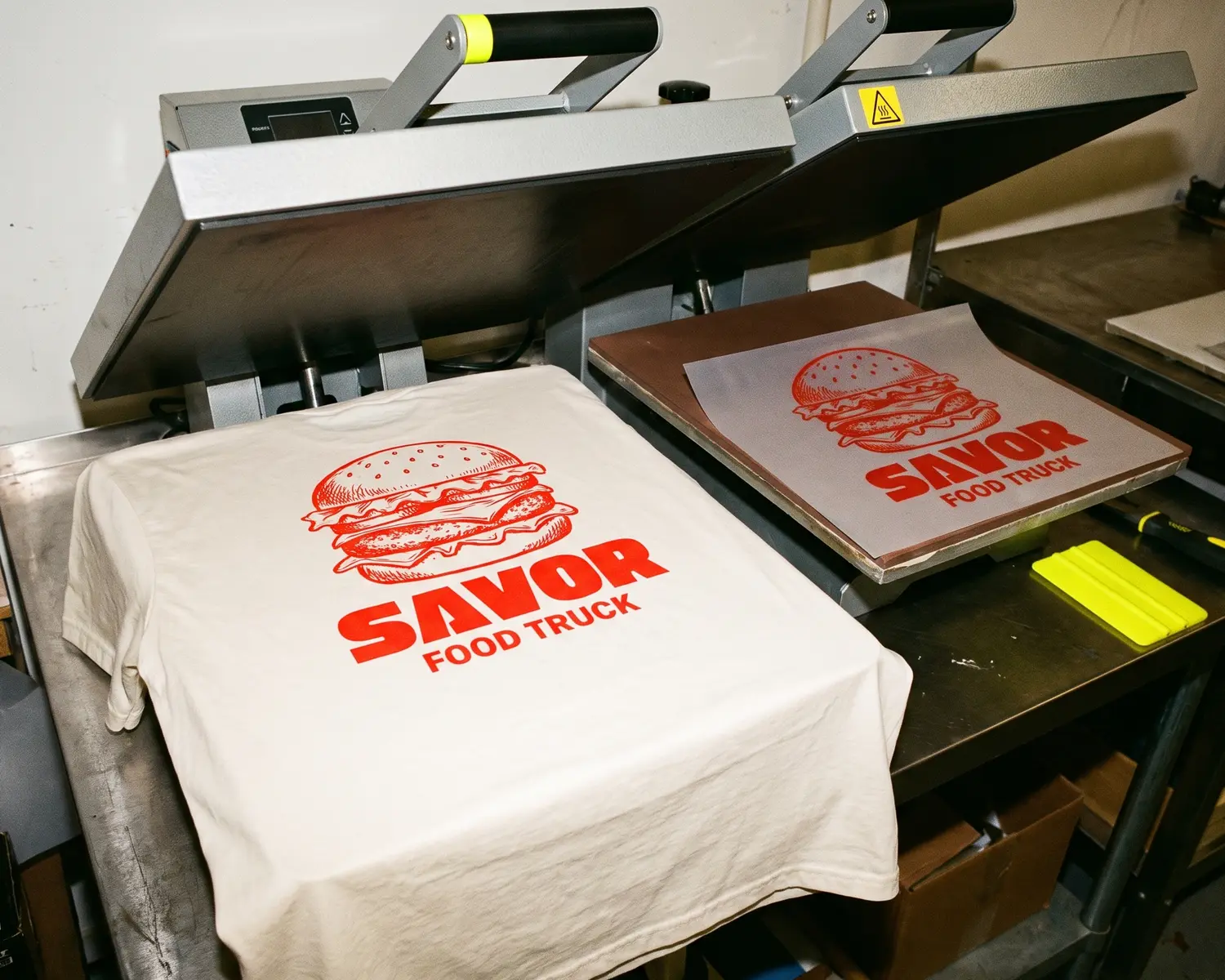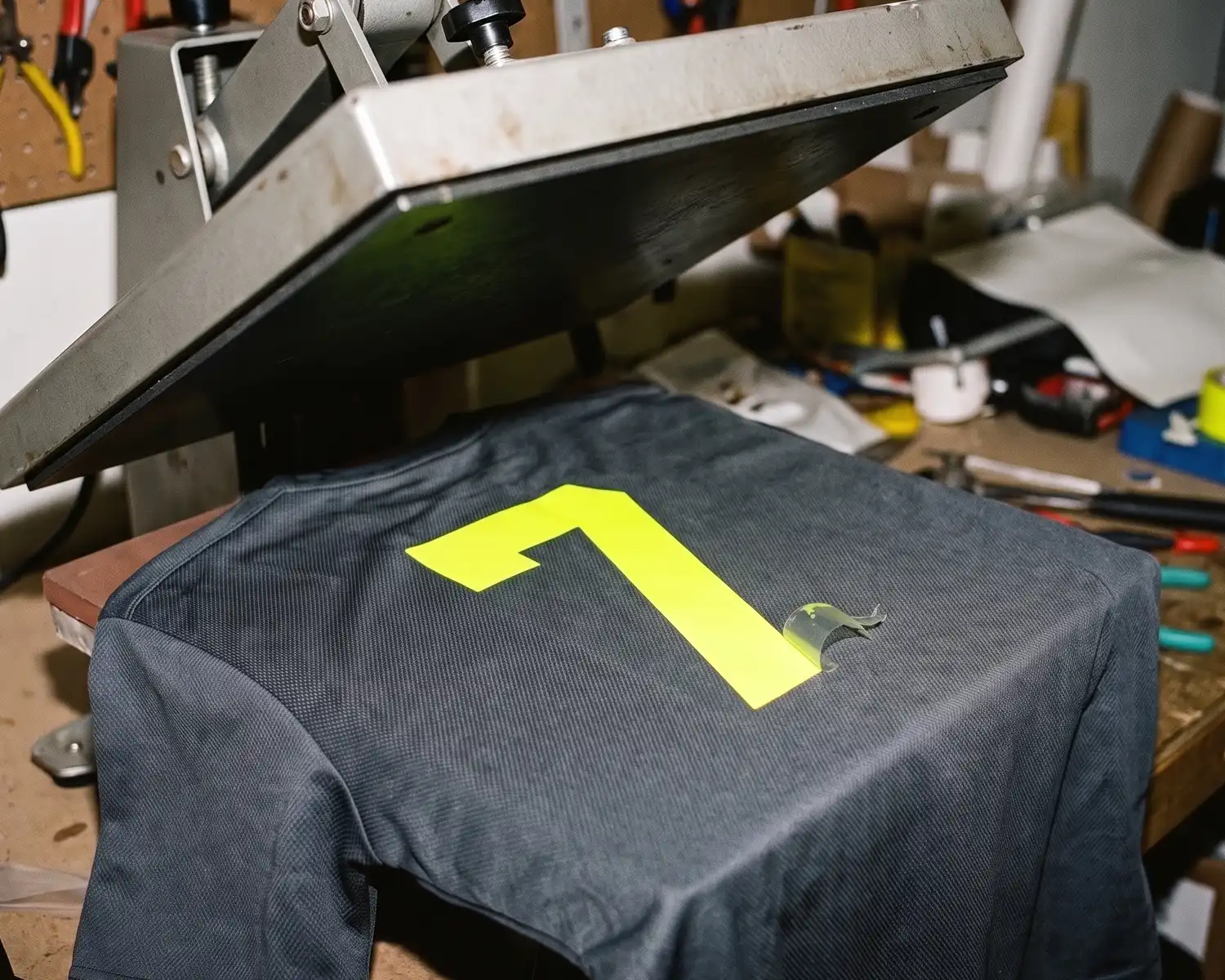
Textile transfer paper is a sheet you print at home, then apply to a garment under heat and pressure. Ideal for a few personalized pieces, it shows its limits in the wash and on larger runs: from about ten garments, a workshop becomes more consistent and often cheaper.
You have seen the sheets in the store or online, and the idea is tempting: print your design at home, one shot of heat, and the t-shirt is done. This guide tells you everything the packet does not: how transfer paper really works, what it looks like on the garment, what it costs per piece once the failed sheets are counted, and the precise moment when going through a workshop becomes the smart choice. Without selling you the sheets or the workshop: each has its own ground.
Transfer paper in plain words: what you are actually buying
Textile transfer paper is a special sheet, usually A4, that you print at home with a regular printer, then apply to the garment under heat and pressure. The ink does not penetrate the fabric: it is a printed film that bonds to the surface. That detail explains everything else: the look, the feel, the durability.
Three things to know before you even buy the packet:
Light and dark are two different papers. Paper for light fabrics is transparent: everything white in your design will be... the color of the t-shirt. Paper for dark fabrics has an opaque white backing: it must be cut close to the design, otherwise you transfer an entire white rectangle. Buying the wrong packet is the classic purchasing mistake.
Inkjet and laser are not interchangeable. Each paper is designed for one type of printer: an inkjet sheet in a laser printer can melt on the drum. Check the box AND your printer.
It is not heat transfer vinyl. The other product on the same shelf, vinyl (flex), is a colored film you cut (often with a cutting machine) and then press. No printer involved: vinyl makes solid shapes and lettering, transfer paper reproduces a complete image, photos included. Two tools, two uses.
Clothes iron or heat press: the gesture that changes everything
A transfer needs two things to hold: a precise temperature and strong pressure, uniform across the whole surface, for a set time. That is exactly what a clothes iron does badly: its soleplate has hotter and cooler zones, its steam holes create gaps, and the pressure depends on your arm. The iron works, but it explains the lottery of DIY results: same paper, same t-shirt, and one transfer lasts three months while the previous one peeled at the second wash.
The heat press fixes all three variables at once: a heated platen at a set temperature, calibrated pressure, a timer. It is the tool that turns tinkering into a small workshop. Entry-level presses have become affordable, and if you plan to customize regularly (an association redoing its t-shirts every year, a small creative activity), it changes the game. For a one-off project of three pieces, the iron remains defensible: provided you press hard, on a hard surface (not the soft ironing board), steam off.
An honest benchmark: if you are hesitating over buying a press for ONE project, it is usually the sign that the project already belongs in a workshop.
What it really looks like on a t-shirt
Let's talk results, without the catalog or the trial. A well-made home transfer, on light cotton, with a suitable design: it is clean, the colors are there, and for a birthday, a bachelorette party or a prototype, it does the job perfectly.
Now, what the packet does not say:
The feel. The design is a film sitting ON the fabric: you can feel it under your fingers, and on light fabric its transparent outline can shine in the light. The "ink in the fiber" look of professional printing (screen printing, DTG) is not achievable with this technique; our screen printing or flex comparison shows what those processes render.
The wash. This is the real frontier. A well-applied home transfer survives a handful of washes in good shape, then ages: cracks along the folds, lifting edges, fading colors. Cold wash, inside out, no dryer: these precautions extend the design's life, they do not change its nature. A garment worn every week will eventually show a tired transfer; an event t-shirt worn three times will stay pristine.
The fabrics that do not forgive. Cotton and mostly-cotton blends play along. Stretch fabrics (the elastane of sportswear) crack the film, heat-sensitive materials (some synthetics) scorch under the iron, and textured surfaces bond poorly. The plain cotton t-shirt remains DIY's ideal ground.
The true cost per piece
The packet of sheets is cheap, and that is what makes the technique attractive. The full calculation is a little different: count the sheets, the ink (full-page designs are thirsty), and above all the failures, because there will be some: the first sheet printed the wrong way (the forgotten mirror), the misaligned transfer, the one that did not bond. On a first project of 5 t-shirts, two lost sheets are the norm, not the exception. Add the price of the garments themselves, failures included, and your "almost free" piece has a real cost quite comparable to a small workshop run, your time not included.
Where the calculation truly flips is volume. Ten, twenty, thirty pieces with a clothes iron is an entire evening of pressing piece by piece, with quality varying from the first to the last, and a sheet cost that climbs linearly. Workshops, on the other hand, get cheaper as quantity rises: it is mechanical, their fixed costs dilute (our survey of flex printing prices shows it with dated figures). DIY is unbeatable at 3 pieces; it flips completely at 30.
When DIY wins, when the workshop wins
The honest frontier, four lines on each side.
Transfer paper wins: the personal or family project in very small quantity, the single piece, the prototype to test a design before a real run, the pleasure of making it yourself, the absolute last-minute emergency.
The workshop wins: the run (from about ten pieces, time and consistency tip the same way), the garment that represents someone (a club, a company, an association: a peeling logo speaks volumes despite you), durability over time (a garment worn and washed every week), and the delicate or dark materials where home transfer reaches its limits.
The simplest test is one question: who will wear this garment, and for how long? A bachelor party t-shirt lives one weekend: make it yourself, have fun. A team polo lives two seasons in front of an audience: entrust it (our guide to getting t-shirts printed walks through that journey step by step), and keep the transfer paper for the mockup that convinced everyone.
If your project tips toward the workshop side, the reflex is simple: compare two or three quotes near you, design in hand. That is exactly what the directory is for.
FAQ
Questions fréquentes
How many washes does transfer paper last?
There is no universal number: durability depends on the paper, the application and the care. A well-applied home transfer stays good-looking for a handful of washes, then ages (cracks, edges, colors). Cold wash, inside out, no dryer: the routine that extends its life.
Does transfer paper work on a black or dark t-shirt?
Yes, but with the SPECIAL dark-fabric paper, with its opaque white backing: light-fabric paper is transparent and disappears on black. The design must be cut close, otherwise you transfer an entire white rectangle.
Why is my transfer cracking or peeling off?
Almost always an application problem: temperature too low, pressure insufficient or uneven (the clothes iron is a repeat offender), or a stretch fabric working under the film. The heat press fixes the first two; fabric choice fixes the third.
Do I need to print the design mirrored?
For light-fabric paper, yes: the design is placed face down on the fabric, so it must be printed reversed. For most dark-fabric papers, no: the design is placed face up. It is written on the packet's instructions, and it is the first thing to check: the sheet printed the wrong way is the classic first-attempt failure.
Clothes iron or heat press: should I invest?
For a one-off project of a few pieces, the iron is enough, with its hazards. For regular use, an entry-level press transforms the consistency of your results. And if you are hesitating over investing for a single project, it is often the sign that a workshop is the better answer.
Passer à l'atelier
Vous savez ce qu'il vous faut. Trouvez l'atelier qui le fait.
L'annuaire recense les ateliers ville par ville, avec leurs techniques et leur contact direct. Un devis rapide vous répond sous 24 h.